Posted on Leave a comment

Ponderosa Pine Inoculated with Rhizopogon

Abstract.

Numerous studies have shown that ectomycorrhizal fungi can profoundly affect conifer performance by facilitating nutrient and water uptake, maintaining soil structure, and environmental extremes. However, fertilizing and irrigating practices in seedling production nurseries are very different than field conditions at harsh outplanting sites. More information is needed on the ability of specific mycorrhizal fungi to establish at the nursery and improve seedling performance in the outplanted environment. This study was conducted to test the ability of a specific ectomycorrhizal fungus, Rhizopogon rubescens, inoculated onto the root systems of plug-1 ponderosa pine (Pinus ponderosa) seedlings grown in fumigated and nonfumigated bare-root nursery beds to influence conifer establishment on two harsh, dry sites in southwest Oregon, U.S. After outplanting, survival of Rhizopogon-inoculated seedlings were significantly higher than noninoculated seedlings at both field sites (p < 0.05). Survival averaged 93% for Rhizopogon-inoculated seedlings and 37% for noninoculated seedlings at the Central Point site. Survival averaged 71% for Rhizopogon-inoculated seedlings and 41% for noninoculated seedlings at the Applegate site. Field survival did not differ significantly for ponderosa pine seedlings grown in fumigated compared to nonfumigated beds. Seedling height did not differ significantly between Rhizopogon-inoculated and noninoculated ponderosa pine seedlings or fumigated and nonfumigated beds in the nursery or outplanting sites. Foliar analysis at the Applegate site indicated significantly higher phosphorous contents for Rhizopogon-inoculated seedlings. Results from this study indicate that Rhizopogon inoculated plug-1 ponderosa pine survive at a much higher rate on dry, harsh sites in southwest Oregon. Poor survival by noninoculated pine seedlings grown in both fumigated and nonfumigated beds and outplanted on harsh sites indicate that field survival should be considered one of the more important criteria for selection of Rhizopogon species suitable for nursery inoculation.

Key Words.

Rhizopogon spp.; ponderosa pine; Pinus ponderosa; mycorrhizae; mycorrhizal fungi; spore inoculation; fumigation; transplanting; survival; drought tolerance; conifer nursery. Throughout the western United States, ponderosa pine (Pinus ponderosa Dougl. ex Laws.) trees are planted extensively on a variety of sites in urban, suburban, and forest environments. Disturbed, compacted soils and hot, dry sites are commonly encountered. First-year mortality of planted trees can be high under harsh conditions (Preest 1977; Peterson and Newton 1985; Amaranthus and Perry 1987; Amaranthus and Malajczuk 2001) and foresters, landscapers, and arborists are always interested in cultural practices at the nursery that may improve tree survival and performance. Conifer tree establishment depends on rapid root and ectomycorrhizal formation on dry sites difficult to regenerate (Amaranthus and Perry 1989). In the arid western United States, transpiration potential during the growing season can exceed soil water availability, killing or reducing growth of nonirrigated seedlings. Ectomycorrhizae enhance water uptake by their hosts (Trappe and Fogel 1977; Reid 1979; Parke et al. 1983), although tolerance to low water potentials vary widely among mycorrhizal species (Mexal and Reid 1973; Theodorou 1978; Parke et al. 1983). Amaranthus and Malajczuk (2001) found Rhizopogon rubescens mycorrhizal colonization of longleaf pine seedlings (Pinus palustris Mill.) significantly reduced plant moisture stress at low soil moisture levels. Plant moisture stress levels averaged 78% higher for noninoculated seedlings compared to Rhizopogon-inoculated seedlings at low soil moistures. Theodorou and Bowen (1970) also observed that P. radiata seedlings inoculated with R. luteolus survived a particularly dry summer better than nontreated seedlings. Sands and Theodorou (1978) found leaf water potentials of Rhizopogon-inoculated seedlings were lower than for noninoculated seedlings.

Numerous studies have shown improvement of outplanting performance of Rhizopogon-inoculated seedlings in conifer establishment. (Volkart 1964; Theodorou and Bowen 1970; Theodorou 1971; Momoh 1976; Castellano and Trappe 1985; Ekwebelam and Odeyinde 1985, Amaranthus and Perry 1989, Castellano 1996). Nutrient acquisition is considered a major factor improving seedling growth. Significantly increased uptake of phosphorus has been reported for mycorrhizal inoculated conifer seedlings(Theodorou and Bowen 1970; Lamb and Richards 1971, 1974; Skinner and Bowen 1974a, 1974b; Chu-Chou 1979, Chu-Chou and Grace 1985), as well as potassium (Theodorou and Bowen 1970; Lamb and Richards 1971), sodium (Melin et al. 1958), total nitrogen (Chu-Chou and Grace 1985), and ammonia forms of N (Finlay et al. 1988).

Considerable effort and expense is directed toward site preparation at many suburban and urban sites. Mycorrhizal inoculum density and viability are often reduced as of a result of site preparation activities (Amaranthus et al. 1994, 1996; Dumroese et al. 1998). Amaranthus et al. (1996) found significant reductions in mycorrhizal abundance and diversity, including Rhizopogon spp. with moderate to high levels of organic-matter removal and soil compaction. Rhizopogon spp. produce belowground fruiting bodies that require animals to spread spores via fecal pellets. They do not produce airborne spores, which makes it unlikely that Rhizopogon mycorrhizal fungi would quickly be introduced from surrounding natural areas to disturbed urban and suburban sites.

The role of mycorrhizal fungi in the health and vigor of trees in stressful environments is well documented. However, more information is needed regarding establishing specific native mycorrhizal fungi in conifer tree nursery environments to increase seedling survival on harsh planting sites. Nursery inoculation of mycorrhizal fungi selected to promote survival and growth in a dry forest, suburban, or urban environment could be an important tool for foresters, landscapers, and arborists. This study was conducted to test the ability of a specific ectomycorrhizal fungus, R. rubescens, inoculated onto the root systems of plug-1 ponderosa pine seedlings grown in fumigated and nonfumigated bare-root nursery beds to influence outplanting performance on two harsh dry sites in southwest Oregon.

MATERIALS AND METHODS Nursery Procedures

On July 1, 1999, ponderosa pine seeds were sown in 2 in3 cells in Stryoblock™ containers at the J. Herbert Stone Nursery in Central Point, Oregon. On July 12, emerging ponderosa pine seedlings were inoculated with 100,000 spores each of the mycorrhizal fungus R. rubescens using an injection of a liquid suspension via a traveling irrigation boom. Spores were applied as a soil drench following maceration of R. rubescens sporocarps for 10 minutes in distilled water. Spore concentrations were determined with a haemacytometer. Foliar fertilizer (250 ppm N, 31 ppm P, and 158 ppm K plus micronutrients) was applied each irrigation during the rapid growth phase. Greenhouse temperatures were held between 65°F and 75°F. In early September 1999, seedlings were hardened-off by reducing irrigation and changing the fertilizer rates (50 ppm N, 60 ppm P, and 150 ppm K plus micronutrients). On September 22, 1999, ponderosa pine seedlings were inoculated again with 100,000 spores each of R. rubescens using the same inoculation procedure. No pesticides were used on the crop during this period.

On September 29, 1999, Rhizopogon-inoculated and noninoculated ponderosa pine were extracted and transplanted into fumigated and nonfumigated bare-root nursery beds at J. Herbert Stone Nursery. At that time 6 Rhizopogon inoculated and noninoculated container seedlings were examined for the percentage of colonization by the mycorrhizal fungus R. rubescens. Mean colonization by R. rubescens on inoculated seedlings was 8%, while no Rhizopogon was present on noninoculated seedlings. Fumigated beds were treated with methyl bromide the prior year, while nonfumigated beds had not been fumigated since October 1996. Prior to transplanting, 200 lb per acre of ammonium phosphate (16-20-0) and 200 lb per acre of potassium sulfate (0-0-50-53) were incorporated into the soils.

After transplanting, seedlings were grown using standard cultural practices for bare-root production. Seedlings were fertilized with 242 lb of N in the form of ammonium nitrate and ammonium sulfate during spring 2000. Root wrenching occurred four times during spring and summer 2000. No pesticides were used on the transplant crop. Seedlings were lifted on January 8, 2001, and those not meeting minimum seedling diameters of 5 mm and seedling height of 13 cm were discarded. Seedlings with poorly developed root systems or J-roots were also removed. Diameters, heights, and root volumes of seedlings to be outplanted were measured on 30 seedlings each from fumigated, nonfumigated, Rhizopogon-inoculated, and noninoculated plots. No significant differences in seedling diameters, heights, or root volumes (p = 0.05) were measured between treatments. Seedlings were placed in cold storage for 4 months until they were outplanted.

Outplanting Procedures

Seedlings were outplanted in two locations in southwest Oregon—the Central Point and Applegate study sites. The Applegate study site is in a small valley at 385 m elevation in the Siskiyou Mountains. Historical annual precipitation averages 650 mm, less than 10% of which falls from mid May through mid-September. Soils are fine loamy, mixed mesic Ultic Haploxeralfs, 60 to 100 cm deep, formed in granitic colluvium and underlain by weathered granitic bedrock. Soils are classified in the Holland series (Soil Conservation Service 1979). Surface layers (to 18 cm) are dark grayish brown to brown sandy loams. Percentages of sand, silt, and clay are 52, 24, and 24 respectively. The study area is on a southwest-facing, gentle (< 5%) toe slope just above the valley bottom. Soil moisture was at field capacity (28%) at the time of outplanting ponderosa pine. The Central Point site is located at the J. Herbert Stone Nursery near Central Point, Oregon, at 426 m elevation on an early level slope (< 5%). Historical annual precipitation averages 500 mm, less than 10% of which falls from mid May through mid-September. Soils are coarse-loamy, mixed, mesic Pachic Haploxerolls, more than 100 cm deep, formed from granitic and metamorphic alluvium. They are classified in the Central Point series. Surface layers are black, sandy loams about 40 cm thick. The planting site is located in an unirrigated field. Soil moisture at the time of planting was at field capacity (15%) at time of planting.

Seedlings were outplanted on May 9, 2001, at both sites. At each site, 16 plots (2 × 2 m) were established for field assessment of Rhizopogon-inoculated/noninoculated and fumigated/nonfumigated treatments. Each area was planted with randomly assigned treatments of nine seedlings each in a 3 × 3 array at 40 cm spacing. Each of the 16 plots were separated by 1 m buffers. The treatments were (1) Rhizopogon-inoculated/fumigated beds, (2) noninoculated/ fumigated beds; (3) Rhizopogon-inoculated/nonfumigated beds; and (4) noninoculated/nonfumigated beds. Each treatment was replicated four times at each site. In September 2001, tree heights at ground line were measured on surviving seedlings and the number of surviving seedlings tallied for each treatment area.

Laboratory Procedures

Before outplanting, five randomly selected seedlings were examined for presence of Rhizopogon ectomycorrhizae for each of the 16 plots. Roots were gently washed free of soil and extraneous material and subsampled in three cross sections, 1.5 cm broad, of the entire root systems in upper, middle and lower positions, respectively. All active tips were tallied as Rhizopogon, other mycorrhizal or nonmycorrhizal from characteristics observed through a dissecting microscope (2× by 10× magnification). Mycorrhizal tips were separated by type according to characteristics observable through a dissecting microscope (2× to 10× magnification). Rhizopogon mycorrhizae identification was verified using color, surface appearance, branching, morphology, degree of swelling, length, and characteristics of rhizomorphs. Rhizopogon rubescens mycorrhizae were creamy white and developed a gradient of yellow and reddish coloration with maturity and upon bruising. The R. rubescens mycorrhizae had a two-layered mantle and abundant rhizomorphs developing a compact coralloid morphology with maturity. In September 2001, pine needle samples were collected from four randomly selected seedlings from each treatment at the Applegate site. Samples were analyzed for total N, P, and K (Kjeldahl digest with ammonia and orthophosphate read on an autoanalyzer).

Statistical Procedures

The experimental design was a randomized block. ANOVA was selected as the primary analysis technique. ANOVAs were performed separately for seedling survival, height, foliar nutrients, and mycorrhizal colonization (Steel and Torrie 1980). Means comparisons were calculated using Fisher’s LSD. Residuals from the performed ANOVAs were examined using, normal probability plots, tests that the residuals come from normal distributions, and plots of residuals versus predicted values. Before analysis, data were logarithmically transformed to compensate for log-normally distributed values (Steel and Torrie 1980).

RESULTS AND DISCUSSION

Ponderosa pine outplanting survival following Rhizopogon inoculation was significantly higher compared to noninoculated seedlings (p < 0.05; Figure 1 and Figure 2*). The average seedling survival for Rhizopogon-inoculated seedlings was 93% compared to 37% for noninoculated seedlings for the Central Point site. The average seedling survival for Rhizopogon-inoculated seedlings was 71% compared to 41% for noninoculated seedlings for the Applegate site. Seedling height at the time of outplanting and after the first growing season in the outplanting environment was not significantly different for any treatment and site combination (Figure 3).

Rhizopogon mycorrhizal colonization was significantly higher on Rhizopogon-inoculated seedlings compared to noninoculated seedlings (Figure 4). Seedlings from fumigated beds had higher Rhizopogon colonization (28%) compared to nonfumigated beds (17%) and noninoculated seedlings from fumigated and nonfumigated beds (1%). However, there were no statistical differences between survival of Rhizopogon-inoculated seedlings from fumigated and nonfumigated beds (Figure 5).

Foliar phosphorous contents were significantly higher on Rhizopogon-inoculated seedlings outplanted from both fumigated beds and nonfumigated beds (Figure 6). Phosphorous percentages were 90% and 60% higher on Rhizopogon-inoculated seedlings outplanted from fumigated beds and nonfumigated beds, respectively, compared to noninoculated seedlings. Foliar nitrogen and potassium levels were higher but not significantly different from noninoculated seedlings (p < 0.05) from fumigated and nonfumigated beds planted at the Applegate site.

Seedlings planted in the western United States are usually subjected to low rainfalls and high temperatures during the summer months after spring outplanting. In our study, both outplanting areas represent typical harsh sites encountered in southwestern Oregon. Rainfall in the months following outplanting of our study was very low (56 mm between May 1 and October 1, 2001), and afternoon ambient air temperatures were high (temperatures exceeded 32°C on 49 days between May 1 and October 1, 2001). As a result, many seedlings at the Central Point site showed signs of wilting and mortality as early as the end of June, 6 weeks after outplanting. Seedlings continued to die as the summer progressed and soils dried out. At both outplanting sites, ponderosa pine seedlings with roots colonized by Rhizopogon mycorrhizae, however, survived significantly better than noncolonized seedlings. This finding may be related to the properties and functions of Rhizopogon that decrease plant moisture stress and promote drought tolerance as soils dry out. Amaranthus and Malaljczuk (2001) found that at high soil moisture contents, there were no significant differences in plant moisture stress between Rhizopogon-inoculated and noninoculated of longleaf pine seedlings. But as soils dried down to as low as 4% soil moisture, differences in plant moisture stress between inoculated and noninoculated seedlings became significant, with inoculated seedlings averaging 9.8 bars and noninoculated seedlings averaging 20 bars.

The mechanism by which Rhizopogon mycorrhizae reduce plant moisture stress in dry soil conditions is becoming better understood. On examination of the excavated Rhizopogon inoculated pine seedling root systems, we observed spongy mycorrhizal mantles and abundant rhizomorphs (Figure 7). Hydration and slow release of water to the tree from spongy fungus mantles and rhizomorphs during drought conditions could buffer seedlings and help reduce plant moisture stress. Spongy mantles and rhizomorphs have been noted and described in numerous Rhizopogon studies (Massicotte et al. 1994; Molina and Trappe 1994; Agerer et al. 1996). Rhizomorphs play an important role in water storage and movement (Duddridge et al. 1980; Brownlee et al. 1983; Read and Boyd 1986). Parke et al. (1983) and Dosskey et al. (1990) demonstrated enhanced tolerance to drought stress of Douglas-fir (Pseudotsuga menziesii) seedlings inoculated with R. vinicolor and attribute this enhancement in part to rhizomorph production and function in water storage and transport.

Benefits of inoculating seedlings with Rhizopogon mycorrhizae might not be apparent to managers of bareroot and container nurseries who are trying to produce larger seedlings. The lack of aboveground differences between inoculated and noninoculated seedlings in this study at the nursery is commonly observed by many nursery managers who inoculate with ectomycorrihzae. Why aboveground differences are not apparent in nurseries could be due to the relatively low moisture stress and high soil nutrient levels typical of nursery environments. In our study, nursery seedlings were never subjected to stresses that exceeded a pre-dawn moisture stress of 10 bars. Soils were kept moist for most of the time that seedlings were in bare-root beds except for a 4 to 6 week period in late summer 2000 when the soils were allowed to dry to induce seedling hardening. Since mycorrhizae support seedlings when moisture and nutrients are limiting, their function in the nursery environment might be of limited advantage.

Outplanting benefits of nursery Rhizopogon-inoculation, however, are well documented. Results from studies throughout the world have demonstrated the importance of Rhizopogon spp. as ectomycorrhizal symbionts in the successful establishment of conifers. As early as 1927, Kessel recognized R. luteolus as being among the first fungi to fruit in association with scattered “healthy” radiata pine in Australian nurseries. Chu-Chou (1979) reemphasized the importance of Rhizopogon in conifer plantations and nurseries in New Zealand. Chu-Chou and Grace (1981, 1983) later discovered R. vinicolor and R. parksii to be dominant ectomycorrhizal fungi of introduced Douglas-fir seedlings in nurseries and plantations. In Nigeria, Momoh (1976) has found R. luteolus associated with vigorously growing introduced pines. Rhizopogon ectomycorrhizae also have been associated with the establishment of conifers in Africa (Donald 1975; Fogel 1980; Ivory 1980), Puerto Rico (Volkart 1964), Europe (Levisohn 1956, 1965; Gross et al. 1980; Jansen and de Vries 1989; Parlade and Alvarez 1993; Parlade et al. 1996), New Zealand (Birch 1937; Chu-Chou and Grace 1981, 1983), South America (Garrido 1986), and the United States (Baxter 1928). More recently, the importance of Rhizopogon in increased seedling performance in the field following nursery inoculation was demonstrated in the Oregon Coast Range. Amaranthus and Perry (1994) inoculated nursery-grown containerized Douglas-fir seedlings from six families with spores of R. vinicolor. Inoculated and noninoculated seedlings from all families were outplanted in the Oregon Coast Range. Rhizopogon vinicolor-colonized seedlings from all families had significantly greater height growth (six of six families) and basal area growth (five of six families) compared to noninoculated seedlings.

The finding of no significant difference between survival of fumigated and nonfumigated seedlings has implications to nurseries that are moving away from using soil sterilants. Soil fumigation with broad-spectrum biocides is a nonselective means of killing soilborne pathogens in tree seedling nurseries (Linderman 1994; Marx et al. 1979). Nursery practices that utilize methyl bromide or other soil sterilants are known to reduce or eliminate mycorrhizal fungi (Lee and Koo 1985; Davies 2002). At J. Herbert Stone Nursery, the soils of the nonfumigated treatments had been fumigated 3 years before the seedlings were transplanted in this study. During this period, changes in soil biological composition and the reintroduction of mycorrhizae, including Rhizopogon spp., have been slow. Rhizopogon spp. produce belowground fruiting bodies that do not disperse their spores through the air, thus making reintroduction from natural areas more difficult. The results of our study suggest that if mycorrhizae-colonized seedlings are to be produced in bare-root fields, inoculation with specific mycorrhizae will be necessary until a desirable population of mycorrhizae becomes established in nonfumigated nursery fields.

The importance of ectomycorrhizal fungi in the uptake and translocation of nutrients to their host plants has been the underlying principal in numerous studies of conifers. Of particular importance is the role of ectomycorrhizal fungi in phosphorous nutrition. Ectomycorrhizal fungi produce acid phosphatases, a special type of root exudate that hydrolyses organically bound phosphorous. Bowen and Theodorou (1968) found that R. roseolus cultures were able to solubilize rock phosphate, and Theodorou (1968) also indirectly showed substantial phosphatase activity by R. roseolus. Skinner and Bowen (1974) demonstrated the uptake and translocation of phosphate via mycelial strands of pine mycorrhizae. Ho and Trappe (1987) found that six Rhizopogon spp. tested produced acid and alkaline phosphatases as well as nitrate reductase, an enzyme that aids the acquisition of nitrogen. Ho and Trappe (1980) report that R. vinicolor produced high levels of nitrate reductase compared to other ectomycorrhizal fungi. In our study, Rhizopogon-inoculated pine seedlings had significantly increased levels of foliar phosphorous compared to noninoculated seedlings in one growing season after outplanting. Rhizopogon-inoculated seedlings also had increased foliar levels of nitrogen and potassium, but differences were not significantly different. The best documented mycorrhizal effect in the literature is that mycorrhizal plants take up more soil phosphorous than nonmycorrhizal plants do. In our study, we see a similar P effect, but it is unlikely that improved phosphorous nutrition had a substantial effect on seedling survival.

Mycorrhizal fungi play a key role in the health and vigor of trees in stressful environments. In southwest Oregon, dry spring and summer conditions often result in significant conifer mortality upon outplanting. Results from this study indicate that Rhizopogon inoculation at the nursery can help seedlings survive and establish on difficult sites. Nursery inoculation of specific mycorrhizal fungi, such as Rhizopogon spp., selected to promote survival and growth in dry and disturbed forest, suburban, and urban environments could be an important tool for foresters, landscapers, and arborists.

Figure 1. Seedling survival after outplanting Rhizopogon-inoculated and noninoculated ponderosa pine seedlings from the outplanting sites at the USDA Forest Service J. Herbert Stone Nursery at Central Point and Applegate, Oregon. Bars represent means, and vertical lines represent standard errors. Means that share the same letter do not differ by Fishers LSD test, P = 0.05.
Figure 2. Photograph of one Rhizopogon-inoculated plot (top) and noninoculated plot (bottom) at the Central Point site.
Figure. 3. Seedling height after outplanting Rhizopogon-inoculated and noninoculated ponderosa pine seedlings from fumigated and nonfumigated outplanting sites at the USDA Forest Service J. Herbert Stone Nursery at Central Point and Applegate, Oregon. Bars represent means, and vertical lines represent standard errors. Means that share the same letter do not differ by Fishers LSD test, P = 0.05.
Figure 4. Rhizopogon percentage mycorrhizal colonization before outplanting Rhizopogon-inoculated and noninoculated ponderosa pine seedlings from fumigated and nonfumigated outplanting sites at the USDA Forest Service J Herbert Stone Nursery at Central Point and Applegate, Oregon. Bars represent means, and vertical lines represent standard errors. Means that share the same letter do not differ by Fishers LSD test, P = 0.05.
Figure 5. Survival percentage after outplanting Rhizopogon-inoculated and noninoculated ponderosa pine seedlings from fumigated and nonfumigated outplanting sites at the USDA Forest Service J Herbert Stone Nursery at Central Point and Applegate, Oregon. Bars represent means, and vertical lines represent standard errors. Means that share the same letter do not differ by Fishers LSD test, P = 0.05.
Figure 6. Foliar NPK percentage after outplanting Rhizopogon-inoculated and noninoculated ponderosa pine seedlings from fumigated and nonfumigated outplanting sites at the USDA Forest Service J Herbert Stone Nursery at Central Point and Applegate, Oregon. Bars represent means, and vertical lines represent standard errors. Means that share the same letter do not differ by Fishers LSD test, P = 0.05.
Figure 7. Photograph of Rhizopogon-mycorrhizae with spongy mantle and abundant rhizomorphs.
Posted on Leave a comment

Mycorrhizae-How It Works?

What Are Mycorrhizae?

“Myco” – “rhiza” literally means “fungus” – “root” and describes the mutually beneficial relationship between the plant and root fungus. These specialized fungi colonize plant roots in a symbiotic manner and extend far into the soil. Mycorrhizal fungal filaments in the soil are truly extensions of root systems and are more effective in nutrient and water absorption than the roots themselves. More than 95 percent of terrestrial plant species form a symbiotic relationship with beneficial mycorrhizal fungi, and have evolved this symbiotic relationship over the past several hundred million years. These fungi predate the evolution of terrestrial plants, and it was the partnership with mycorrhizal fungi that allowed plants to begin to colonize dry land and create life on Earth as we know it.

The mycorrhizal symbiotic relationship centers on the plant’s ability to produce carbohydrates through photosynthesis and share some of these sugars with the fungus in return for otherwise unavailable water and nutrients that are sourced from the soil or growing media by the extensive network of mycelial hyphae produced by the fungus. It’s a two-way relationship of sharing resources between two species, thus a classic symbiotic mutualism. The endomycorrhizal fungi rely on the plant, and the plant’s performance and survival are enhanced by the fungus.

How is this Symbiosis Established?

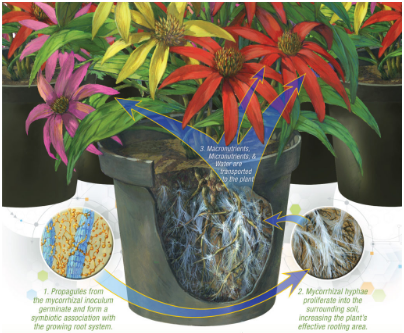
Mycorrhizal fungi can colonize plants from three main sources of inoculum: spores, colonized root fragments, and vegetative hyphae. Collectively, these inoculants are called “propagules,” and this is the standard unit of measure that is listed on most commercially available mycorrhizal products.

To colonize plant roots, these propagules must be present in the substrate and in close proximity to actively growing roots of a compatible plant. The growing root tips emit root exudates as they push through the substrate which signal the fungi to colonize the roots and establish the symbiosis. Once the roots are colonized, then the process is self-sustaining as the mycelia continue to grow with the plant’s root system and additional spores and hyphae are produced.

AMF propagules can be incorporated into the substrate prior to or during planting or they can be top-dressed on the surface and watered into a porous substrate. They can also be applied as a dip or slurry at the time of sticking a cutting, seeding, or at the time of transplanting. The propagules can also be applied as a drench to the soil and watered-in, applied to the outer surface of the rootball before transplanting, or used in transplant hole and backfill soil.

What are the Main Benefits of Mycorrhizae? There are numerous documented benefits that mycorrhizal fungi provide to plants. The key benefits that mycorrhizae provide to professional growers are Root System Enhancement, Improved Nutrient Efficiency, and Increased Water Absorption & Utilization.

What are Some of the Other Benefits of Mycorrhizae?

The symbiotic relationship with mycorrhizal fungi provides many additional benefits to plants and their environments, along with the top-three listed above. These additional benefits include Improved Soil Structure, Greater Transplant Success, Increased Stress Tolerance, Reduced Nutrient Runoff, and many more.

Who Can Benefit from Mycorrhizal Fungi?

This biological or “bio rational” technology, as we like to call it, is beneficial to every industry involving soils, plants, and people. These symbiotic organisms have been relied upon for successful reforestation and restoration projects for decades. In agriculture, mycorrhizal fungi are partnering with plants in symbiosis to contribute to sustainably feeding our growing global population, even in drought-affected areas, salty soils, desertified farmland, etc. Professional horticulturists, including greenhouse and nursery growers, can also experience the benefits of mycorrhizae in their own growing protocols to grow heartier, more vibrant, and more resilient plants for retail sale and landscape installations. Landscape architects, installers, and maintenance workers have been utilizing mycorrhizal inoculants in transplanting and sustainable landscape design for at least the last couple of decades. Even homeowners who are planting gardens and/or caring for their lawns and landscapes can now utilize this technology, as more and more mycorrhizal retail products are showing up on shelves in garden centers.

What are the Different Types of Mycorrhizal Fungi?

How Many Species of Mycorrhizae do I Need?

One of the many benefits of adding mycorrhizae into your growing practices is the fact that these beneficial symbiotic organisms are involved in building a healthy ecosystem for your plants within the growing media rhizosphere. And like any healthy ecosystem, biodiversity is very important. Therefore, selecting products with greater numbers of species of the types of mycorrhizal fungi that you need (either endo mycorrhizae, ectomycorrhizae, or both), will offer greater benefits to your plants, throughout their entire life cycles.

Research has shown that the diversity of mycorrhizae in the plant’s root system is important, as these different species of mycorrhizae provide different benefits to the plant under variable circumstances. For instance, some species are better at assisting in nutrient uptake, while others are more proficient in assisting the plant with water efficiency, and others are responsible for mitigating toxins and salts from reaching the plant’s vascular system. Research has also shown that different species of mycorrhizae provide different benefits during different seasons, with some doing the heavy lifting early in the growing season, and others kicking in during the warmer drier months, and others providing benefits towards the end of the growing season or throughout the winter.

Therefore, we recommend choosing products with greater diversity (at least 4 species in endomycorrhizal products, and at least 7 species in ectomycorrhizal products), in order to ensure that you are providing the ideal soil microbiome for your growing operation, landscape installation or maintenance, restoration project, arbor care, etc.

Posted on Leave a comment

Farmers’ Fungus That Pays Big Dividends

Hidden from view beneath the soil surface in the farmer’s field there is a relationship between fungi and plants that is fundamental to life on the planet. Fungi can’t make their own food, they have to absorb their nourishment from living or dead organic matter. Organisms like fungi help assure the earth’s resources recycle as they should. There is one particular group of fungi that works in cooperation with important crop species. This article will shed some light on this special “farmers’ fungus” that pays big dividends. We have come to understand that in natural habitats, plant roots are a complex mixture of both fungi and plant. This relationship is called a “mycor-rhiza” which literally means ‘fungus-root’. Approximately nine out of every 10 species of plants form an association with these specialized mycorrhizal soil fungi in order to thrive. The plant needs the fungus and the fungus needs the plant. The fungus is responsible for getting the nutrients and water from the soil, and in return, it gets carbohydrates from the plant (figure 1). This is what is called a “symbiotic” relationship; one in which both plant and fungus benefit. The fossil evidence indicates that this plant/fungus relationship dates back over 460 million years.

What are they?

The body of the fungus consists of very thin strands called hyphae (figure 2). In healthy soils, these strands grow from within the root cells of the crop and spread out into the soil, greatly increasing the surface area of the root system. The most widespread type of mycorrhizal relationship are known as arbuscular mycorrhizae (also known as “endo” mycorrhizae) and are formed by most agricultural plants. These plants include most grains, vegetables, fruit and nut trees, vines and turf grasses.

What they do

The mycorrhizal relationship effect on the root system is dramatic. Most of the absorbing area of the root system is actually fungal hyphae. Hyphae are much thinner than roots or root hairs and are able to penetrate the tiniest pores in the soil. A thimbleful of healthy soil can contain miles of fungal hyphae! As a result, the efficiency of the plants’ nutrient and water uptake is increased enormously. Agricultural soil often contains abundant nutrients but availability to the crops themselves can be limited. Research demonstrates that mycorrhizae are particularly important in mobilizing phosphorus, nitrogen, zinc, iron, calcium, magnesium, manganese, sulfur and other tightly bound soil nutrients, transporting them back to the plant. This plant-fungus relationship can pay of big on the farm. Crop plants become able to absorb soil nutrients previously unavailable and utilize fertilizer inputs much more efficiently. The result is often significant savings in fertilizer costs (figure 3).

Water, water everywhere?

Agriculture’s need for fresh water is growing faster than nature can provide. It’s quickly becoming one of the key resource issues of the 21st century. How do natural areas provide for such luxuriant plant growth without irrigation? One key factor are the mycorrhizal threads attached to plant roots scouring the soil for available resources. They absorb water during periods of adequate soil moisture, then retain and slowly release them to the plant during periods of drought. Natural areas have achieved a level of drought tolerance that far exceeds agricultural areas partially because an enormous web of mycorrhizal threads act as a sponge, protecting plant communities from extreme moisture deficits. The mycorrhizal threads can penetrate into the small soil pores to access pools of water that are unavailable to the thicker roots. An extensive body of research has documented the importance of the mycorrhizal relationship for efficient water use and drought protection for a wide array of important crop species. The ever-increasing cost and declining quality of water are formidable issues facing farmers today. Today, mycorrhizal fungi can be a powerful tool for farmers seeking to improve water-use efficiency and lower irrigation costs.

Figure 3. The mycorrhizal corn plant on the left can retain and absorb fertilizer compared to the non-mycorrhizal corn plant on the left.

Does my farm have mycorrhizal fungi?

Some modern agricultural practices reduce the biological activity in soil. Fungicides, chemical fertilizers, cultivation, compaction, soil erosion and periods of fallow can all adversely affect beneficial mycorrhizal fungi. Extensive testing of agricultural soils indicates that many intensively managed lands such as agricultural fields lack adequate populations of mycorrhizal fungi. Farming extensive acreage affects the mycorrhizal relationship in two fundamental ways. First, it isolates the crop plant from the beneficial mycorrhizal fungi available from natural settings. Secondly, it increases the need for water, nutrients, and soil structure required to sustain a healthy crop. Once lost from a farm, arbuscular mycorrhizal populations are very slow to re-colonize, unless there is close access to natural areas that can act as a source of mycorrhizal spores and hyphae to re-populate the affected area. Arbuscular mycorrhizal fungi do not disperse their spores in the wind, but rather grow from root to root. The spores do not easily move long distances back to the farm soil from undisturbed natural sites. Unfortunately, growing crops immediately adjacent to undisturbed natural ecosystems is not always an option on the modern farm.

How do I use mycorrhizal inoculants on my farm?

A farmer can enhance crop root growth, nutrition and yield, reduce irrigation and ameliorate many problems resulting from intensive agriculture by inoculating with mycorrhizal fungi. A more sustainable approach to crop establishment and growth includes using mycorrhizal fungi as an inoculant before, during, or following planting. The goal is to create physical contact between the mycorrhizal inoculant and the crop roots. They can be sprinkled onto roots during transplanting, banded with or beneath seed, used as a seed coating or watered in via existing irrigation systems. Treating seed either before or during sowing produces excellent results. Just one pound of a mycorrhizal inoculant concentrated powder can easily treat enough seed to plant one acre. The type of inoculum product and application method depends upon the conditions and needs of the crop and farmer. Generally, mycorrhizal application is easy, inexpensive, and requires no special equipment. Liquid forms of mycorrhizal inoculants are becoming very popular due to the ease of handling, mixing, storage, and their effectiveness in penetrating many soil types and treating existing plants. It is also now possible to have vegetables, fruit and nut crops which begin their life cycle in a nursery inoculated with mycorrhizal fungi. Unfortunately, most crop plants raised in nurseries are started in sterile soils and receive intensive fertilization, water, and pesticides. Although these artificial conditions can produce vast volumes of plants, they also result in non-mycorrhizal plants that are often poorly adapted to the eventual out-planted conditions on the farm where they will be subject to the harsher environment of the open field. Conversely, nursery-grown plants that have already been colonized with mycorrhizal fungi are better equipped to take advantage of soil resources and can establish rapidly and successfully in the field.

What about Fungicides?

Of course, mycorrhizae are fungi so it stands to reason that some fungicides will reduce or eliminate them from the soil and roots. Fortunately, research and experience indicates that certain types of fungicides do not adversely affect mycorrhizae. A list of common agricultural fungicides and their effects on mycorrhizae can be accessed at BioStim. Sometimes it helps to apply fungicides four to six weeks prior to the mycorrhizal treatment. Mycorrhizal inoculums may also be applied after the use of a fungicide. Follow manufacturers’ guidelines for the time required for the fungicide to “clear” the soil media.

Farm fungi pay dividends

Many mainstream agricultural markets are already benefiting from the use of mycorrhizal inoculums, and use continues to increase dramatically. Recent advancements in mycorrhizal research and application technology have made farm use of mycorrhizae easier and more cost effective than ever. The economic return for mycorrhizal inoculation can exceed its cost several-fold, not only from increased yields, but also by reduced fertilizer, and water costs. Using a mycorrhizal inoculant, Del Gates of North Dakota increased flax yields by 27%. Ron Miller’s wheat farm in Nebraska increased its yield of organic wheat by 42% by treating the seed with a mycorrhizal inoculant powder. Agronomists in California’s San Joaquin Valley documented a 20% yield increase of sorgum sudan grass at four different seeding rates following mycorrhizal inoculant treatment. Other studies have shown similar success with onions, alfalfa, melons, garlic, carrots, rice, strawberries, tomatoes, potatoes, almonds and a host of other crops where yield increases have ranged from 10 – 40%, often with reduced inputs and cost. Learning about the role of mycorrhizal fungi and the conditions that inhibit or promote their presence in the soil is the first step toward healthier crops, increased yields and lower costs. The next step is to add the fungi to the root zone when planting or transplanting and when restoring distressed soils. Good soil is a precious resource containing millions of years worth of nutrients and microorganism development. However, to be successful the farmer requires an appreciation of the “friendly fungus” that can pay big dividends.

Posted on Leave a comment

From Light To Life: Restoring Farmland Soils

Solar isn’t just for rooftops. It builds soil too!

It may come as a surprise to many to find that in healthy soil there is a poor relationship between plant productivity and the amount of applied nitrogen (N) or phosphorus (P). Recent research undertaken by Dr David Johnson and his team at New Mexico State University (NMSU) found there are other factors of much greater importance. What are these factors? And what can farmers do to optimise them?

The NMSU researchers discovered that plant growth is highly correlated with how much life—and what kind of life—is in the soil. In fact, microbial community structure, particularly the ratio of fungi to bacteria, had significantly more influence on yield than the concentration of inorganic N or P.

Given that flourishing communities of beneficial soil microbes are the ‘key’ to plant production, what is the secret to ensuring the right microbes are present in the right amounts?

Plants. That’s right. The most important factor for promoting abundant plant growth is to have green plants growing in the soil all year round.

The plant-microbe-soil connection

You may have heard that ‘plants take from the soil‘. Nothing could be further from the truth. Observe what happens in bare soil. It dies. Then it blows or washes away. If you could ’see’ what happens around the roots of actively growing plants you would want to have as many green plants in your soil for as much of the year as possible. The NMSU researchers found that planting diverse cover crops between cash crops resulted in better yields than the use of synthetic fertilisers and that wasn‘t all. Soil tests showed that the availability of essential minerals and trace elements increased. How does it work? Carbon inputs from living plants support the microbial activity required to improve soil structure, increase macro- and micronutrient availabilities and enhance soil water-holding capacity. In turn, these factors improve plant productivity. It’s a positive feedback loop.

The NMSU research team found that as cover drop density increased, the effect became quadratic, due to the synergies between living plants and soil microbial communities. That is, 1 + 1 = 4.

It all starts with photosynthesis

The energy needed to maintain flourishing soil ecosystems begins as light. This energy must cross two bridges in order to recharge the soil battery. First, the photosynthetic bridge. In the miracle of photosynthesis, light and CO2, are transformed to biochemical energy (carbon compounds) in the leaves of green plants.

Second, the microbial bridge. In the presence of beneficial bacteria and fungi photosynthetic rate increases and carbon ‘flows’ from plant roots into soil microbial intermediaries.

If one of these bridges has been blown (e.g. no green plants or compromised microbial communities), soil health declines.

Every summer, around 22 million hectares of Wheatbelt soils lie bare across eastern, southern, and western Australia. Herbicides are commonly used to maintain the soil in a plant-free state. Bare ground and low levels of biological activity result in declining structure, reduced infiltration, poor moisture retention, inadequately buffered pH, and an open invitation to weeds.

Take a step back in time…

Most of the temperate regions currently used for crop and pasture production supported vigorous, diverse groundcover at the time of European settlement. Summers in the southern half of the Australian continent have been hot and dry for thousands of years, yet there were more summer-active than winter-active plants in the original vegetation. This is an important point. It is not ‘natural’ for the soil to be bare over summer (or winter, for that matter).

Despite successive months of summer temperatures above 100° Fahrenheit (37 °C) and little or no rain, observers of the original groundcover reported it to remain remarkably green (Presland 1977). Active growth was possible during hot dry periods because the soil had a high water-holding capacity.

After many decades of the bare ground over summer—every summer—the water-holding capacity of our agricultural soils has significantly declined. The original groundcover contained more broadleaved plants (forbs) than grasses (Lunt et al 1998). Nutritious summer-active native legumes within genera such as Lotus, Hardenbergia, Kennedia, Cullen (formerly Psoralea), Glycine, and Desmodium were once abundant in their respective endemic areas, as were many food plants used by indigenous people, including yarn daisies (Microseris). As a general rule, broadleaved plants are more important than grasses for microbial diversity and nutrient cycling.

Not surprisingly, the most palatable and mineral-dense summer-active plants quickly disappeared from the original groundcover due to unmanaged grazing.

Restoring soil function

The more closely we can mimic the structure and function of year-round species-rich groundcover, the more productive and ‘problem-free’ our agricultural enterprises will be.

If there is sufficient moisture to support summer weeds there is sufficient moisture to support a summer cover crop. Furthermore, it is generally cheaper to sow a summer cocktail than to spray weeds. The purpose of a multi-species cover crop is to restore below-ground diversity which will, in turn, restore biological soil function (natural N-fixation and P-solubilisation) and plant productivity.

The nutrient sourcing and moisture retention benefits of diverse cover crops will continue to build in successive years as soil health improves.

Summer cocktails

Examples of broad-leaved plants that can be used in multi-species summer cover crops (cocktail crops) include sunflowers, buckwheat, chickpea, sunn hemp, amaranth, cowpeas, soybean, safflower, camelina, sugar beet, squash, and lab-lab. These can be combined with a range of plants from the grass family, including pearl and proso millet, sudangrass, forage sorghum, maize, etc. Aim for at least I0 species or varieties in your mix, with more broad-leaved plants than grasses.

Summer cocktail of sunflower, maize, soybean, cowpea, camelina, sugar beet, sudangrass, pearl millet, proso millet, pasja turnip, tillage radish, sweet clover, and squash on Menoken Farm. Cover crops can be either grazed or rolled while green, prior to the sowing of the follow-on crop.

Will there be a yield penalty?

Yield penalties may be observed In crops following summer groundcover If:

i) the summer groundcover did not include a diversity of broadleaved plants (aim for more non-grasses than grasses);

and/or

ii) high rates of inorganic N (e.g. urea) or P (e.g. MAP, DAP) were applied to either the cover crop or the follow-on crop, damaging the microbial bridge. Note: Inorganic N has been applied previously, for several years in succession, N use must be reduced slowly, as populations of free-living N-fixing bacteria will initially be very low.

What’s N got to do with it?

Aside from water, nitrogen is frequently the most limiting factor to crop and pasture production.

Nitrogen is nitrogen, irrespective of the source, but the same nitrogen compounds can have opposite effects, depending on the way they enter the soil and the form in which they exist in plants.

This paradox has created much confusion.

It is neither natural nor healthy for crop and pasture plants to contain high levels of inorganic nitrogen (nitrite, nitrate, etc). Nitrogen is much safer and more productive when in an organic form.

Closing The Nitrogen Loop

The efficiency of the use of applied N is generally less than 50% due to losses from leaching, volatilization, and denitrification (Kennedy et al 2004). These inefficiencies cost farmers a great deal of money as well as contribute to environmental pollution.

Fortunately, biological N fixation is a spontaneous process when adequate carbon is available under actively growing plants, provided large amounts of synthetic N have not been applied. In biologically active soils, sugars and other carbon compounds exuded by plant roots support vast colonies of beneficial fungi and bacteria, which in turn produce sticky substances that glue soil parties together and enhance soil structure.

Once aggregates (small lumps) start to form, free-living nitrogen-fixing bacteria, which require a low partial pressure of oxygen, can begin their work of fixing atmospheric nitrogen. These bacteria are called associative diazotroph, ‘associative’ because they are only found inside aggregates attached to living plant roots or connected to plants via the hyphae of mycorrhizal fungi-and ‘diazotrophs’ because of their ability to use nitrogenase enzymes to fix atmospheric nitrogen.

The nitrogen fixed by associative diazotrophs does much more than support plant growth. It also makes a significant contribution to the soil food web and is essential to the formation of stable forms of soil carbon, such as hummus.

In addition to associative diazotrophs, mycorrhizal fungi are indispensable for closing the nitrogen loop. Their ability to transfer organic N from the soil food web into plant roots circumvents the need for nitrogen to be present in an inorganic form (Leake et al 2004, Leigh et al 2009).

The activities of mycorrhizal fungi also contribute to the rapid sequestration of soil carbon.

But here’s the rub.

The applicant on large quantities of inorganic N-such as found in urea, MAP, DAP, etc inhibits the activities of both associative diazotrophs and mycorrhizal fungi. Long-term use of these products results in a decline in soil structure, the decline in soil carbon-and ironically, a decline in soil nitrogen (Khan et al 2007, Mulvaney et al 2009).

Reducing N dependence

Where diverse summer cover crops are being grown to support soil microbial communities, it is advisable to reduce N use, but this must be done slowly, to provide time for free-living N fixing bacteria to re-establish. There is no need for synthetic N in the cover crop provided a variety of broadleaved plants, including legumes, are present. Nitrogen inputs in follow-on crops can be reduced to 80% in the first year, 50% In the second year, and 20% In the third year. In the fourth and subsequent years, the application of a very small amount of N (around 1kg/ha) will help to prime the natural nitrogen-fixing processes in soil. Remember, associative diazotrophs (the most important of the free-living N-fixing bacteria) and mycorrhizal fungi (needed for N transfer to plants) have only one energy source liquid carbon from an actively growing green plant. At the same time as you are weaning your soil off synthetic N, you must also be maintaining as much diverse year-round living groundcover as possible.

Will I need to add P?

Plant roots produce hormones called strigolactones that control root extension, lateral root development, and the production of root hairs. The presence of strigolactones in the soil also stimulates root colonization by mycorrhizal fungi (Czarnecki et al 2013). Vigorous root systems and symbiotic relationships with mycorrhizal fungi are essential for maximizing the ability of crop plants to obtain water, nitrogen, phosphorus, potassium, sulfur, calcium, magnesium, and a wide variety of trace elements such as zinc, copper, boron, manganese, and molybdenum.

Many of these elements are essential for resilience to climatic extremes such as drought and frost. The application of large quantities of water-soluble P such as those found in superphosphate, MAP, DAP, etc inhibits strigolactone production by plant roots. That is, the use of these products will reduce root extension, root hair development, and colonization by mycorrhizal fungi. The long-term results in destabilization of soil aggregates, loss of porosity, reduced aeration, increased soil compaction, and mineral-deficient plants.

In addition to having adverse effects on soil structure, the application of inorganic phosphorus is highly inefficient. Around 80% adsorbs to aluminum and iron oxides and/or forms calcium, aluminum, or Iron phosphates, which, in the absence of microbial activity, do not plant-available(Czarnecki et al 2013). Only 10-15% of fertilizer P is taken up by crops in the year of application.

In old and deeply weathered soils, biological processes are more important than chemical processes when it comes to making nutrients.

Your soil already contains sufficient P, but it will only be in a plant-available form when the right microbes are present. If levels of mycorrhizal colonization are high, there will be no need to add large quantities of inorganic P.

Cover crops (and follow-on crops) can be supported with biology-friendly products such as pelletized compost or liquids such as compost extract, worm leachate, or milk. Compost extract containing around 1kg/ha (no more) of each of N, P, and S, plus whatever trace elements are required (as determined by plant tissue test) should be sufficient in most situations.

Strategic grazing

Land can respond positive y to the presence of animals, but the way they are managed is extremely important. Strategic (high-density, short-duration) grazing of summer groundcover helps to stimulate biological activity and cycle nutrients tied up in plant material. Aim to graze no more than one-third to one-half of the biomass, using mob stocking or strip grazing techniques to ensure the soil surface is completely covered with trampled plant material (Jay Fuhrer, pers. comm.).

Soil responds positively to the presence of appropriately managed animals. Here a mob of dry ewes recycles nutrients and stimulates soil biology by grazing and trampling a cocktail cover crop on Menoken Farm.

Where grazing is not an option, cover crops can be rolled. Menoken Farm.

Putting it all together

Changing fertilizer practice alone is not sufficient to improve soil health. Unless biology-friendly fertilizers are used in combination with diverse year-round living cover the essential microbes won’t be there to be supported. For the same reasons, the presence of summer groundcover alone is not sufficient-indeed it may prove detrimental. There will be a tie-up of N and a yield penalty in the follow-on crop unless key functional groups, particularly the associative diazotrophs and mycorrhizal fungi, are working together. This simply cannot happen if large amounts of inorganic N or water-soluble P are applied.

• Strategic grazing of summer groundcover helps cycle nutrients tied up in plant material. Aim to graze no more than 30-50% and trample the remainder onto the soil surface. If grazing is not an option, cover crops can be rolled while still green.

• There is no need for either synthetic N or P in your ‘summer cocktail’ provided a good range of broadleaved plants, including legumes, are present.

• Remember to wean off N slowly in the follow-on crop. Cut back to 80% in the first year, 50% in the second year, and 20% in the third year, then maintain levels at 1kg/ha/yr. If you feel you must, also apply 1kg/ha/yr of inorganic P and 1kg/ha/yr of S-but no more!

• Improved weed management is one of the many benefits of integrated land management. Most crop and pasture weeds are stimulated by nitrate. The current farming model is essentially creating the problem. Weeds become less of an issue under biological forms of cover cropping. This is partly to do with groundcover but more usually the result of closing the nitrogen loop.

• Above all, the capacity of the soil to absorb and hold water is critical for dryland crop and pasture production. Although it may seem counter-intuitive, the most effective method for improving soil structure and increasing water-holding capacity is to maintain active year-round plant cover, which increases soil carbon, supports microbial activity, and improves the ratio of fungi to bacteria.

From light to life

Diverse summer cover crops are sown with biology-friendly fertilizers are the fastest way to restore soil function in Wheatbelt soils. These principles also apply to dairy, beef, lamb, wool, and horticultural enterprises in the winter rainfall zone.

Sunlight intercepted by bare earth is converted to heat energy, driving evaporation and soil loss.

Sunlight intercepted by green leaves is converted to biochemical energy, fuelling soil life, enhancing soil structure, improving nutrient cycling, and increasing water-holding capacity.

Why not turn ‘light’ into ‘life’ on your farm?

Perhaps just try one paddock to begin? Your soil will love you- you will love your soil.