

Have you used MycoGold in the past?
We would love to hear from you on where you used MycoGold and the results you recieved.
Please click here to send us an email.
Sustainably Yours
Tim Lester
Have you used MycoGold in the past?
We would love to hear from you on where you used MycoGold and the results you recieved.
Please click here to send us an email.
Sustainably Yours
Tim Lester

There is no better time to get into the garden. If you want any mycorrhizal fungi to help those seedlings along you can find it in our store at https://biostim.com.au/shop/myco-gold/ with $10 flat rate shipping to anywhere in Australia.
With all the bad news in the world, I want to do something positive. As a local small business, we are feeling the strain as well. If you have received the government stimulus or have a few extra dollars, we hope to entice you to make a purchase.
For the next week, we will include a 20 gram sample of MycoGold https://biostim.com.au/shop/myco-gold/ with every order. We hope you will give it to someone who might benefit (drop in their letter box and message them) or pass it onto a family member to use.
This is just our little goodwill effort to help get our thoughts off the virus. Get into the garden/land and grow a plant. The vitamin D and fresh air can only be beneficial 🙂
p.s If you have a business and would like some free promotion, send me a reply email with your details to feature in our next newsletter.
Kind regards
Tim Lester

Saprophytic plants, literally, are plants that live of rotting material (sapros = rotting, and phyton = plant in Greek), but in fact, no plant have been found yet which can use dead organic material for food directly.
Anyway, these plants have no chlorophyll in their cells, which means they are unable to assimilate carbon by themselves. They have no green leaves, often they even have no leaves at all. Saprophytes are mostly whitish, but can have brightly coloured flowers. They grow in places with lots of rotting dead leaves, often in deep shade in tropical forests.
In their underground parts (rhizomes or roots) are certain cells that are filled with structures (hyphae) of soil fungi. Often, but not always, these fungi are capable of ‘digesting’ the rotting material and converting it by enzymes into molecules (sugar) which they can feed on. So, the fungi are the real saprophytes, living of rotting material. Now, the plants without chlorophyll digest the fungus that live inside their roots or rhizomes, thus they are not autotrophic/self supporting, but heterotrophic plants (hetero = another, trophein = feed). And because they are living on fungi they are called myco-heterotrophic plants / MHP’s (mycos = fungus). This mycorrhiza (mycos = fungus, rhizon = root) of MHP’s makes it possible for them to grow in places with not enough light for ordinary autotrophic plants to survive. The same might be the case for places without enough nutrients in the soil.
To complicate matters there is evidence that some fungi neither are saprophytes but have underground connections with big forest trees or other autotrophic plants. So the trees, the fungi, and the myco-heterotrophic plants all three together form a kind of plant community, a symbiosis (living together), to make it possible for the MHP to live. In the special case of MHP’s, the linking fungus delivers the assimilated carbon from the autotrophic plant to the myco-heterotrophic plant.


We are still very much interested in new collections of saps, and we are always willing to identify them.
Our knowledge about saprophytes from Africa and Asia is less extensive, but we are interested to study them as well (especially in the genus Thismia).
Here some hints, how to collect saprophytes:
Achlorophyllous plants are puzzling! They are always characterized by remarkable reductions concerning root, shoot and leaf structure and sometimes even hardly resemble a flowering plant. It is no wonder that they are often collected by mycologists! Here some basic information:
Since assimilation of carbohydrates through photosynthesis without chlorophyll is impossible (as far as we know) and the direct metabolization of dead organic material has never been detected in flowering plants, achlorophyllous plants must have another source of carbon. They split up in two distinct groups:
Parasites
These plants develop special organs (haustoria) penetrating foreign plant tissue in order to participate at least to some extend from their host’s assimilates (carbon compounds), water or nutrient uptake (e.g. Dodder, Broomrapes).
Mycoheterotrophic Plants (‘Saprophytes’)
In these plants a fungus (or several?) lives inside their roots (‘mycorrhiza’) providing all requirements for plants growth. This is the plant group that I investigate.

More than 400 species, in 87 genera and 11 families, of mycoheterotrophic plants have been described. Of those, only orchids and members of the Monotropaceae (Indian-Pipe Family) are fairly well investigated. Information about the other families are scarce. The most recent work on the neglected genera has been done by Hiltje and Paul Maas and co-workers in Utrecht/Netherlands. Nevertheless, root structures (morphology, anatomy, mycorrhiza) are often entirely unknown. Most probably this is due to the remote and hardly accessible habitat of these plants, the deep shaded tropical rainforest, and the fact that they are easily overlooked in the field (see the picture to your left!). Hence, they get found by mycologists!
Lately, I focused on the genus Voyria of the Gentianaceae (Gentian Family) where 19 species have been distinguished so far, all except one living in tropical America. Then I looked after Triuridaceae and Burmanniaceae (Triuris, Sciaphila, Burmannia, Dictyostega). Momentarily, I’m working on Burmanniaceae and Polygalaceae (Afrothismia, Epirixanthes). All of these plants share some morphological characters with Voyria but are not at all related to them. I could show that their mycorrhiza is an arbuscular mycorrhiza (AM), a form of fugus-plant-symbiosis which is very well known for more than hundred years. However, the achlorophyllous species so far investigated revealed some very unique features, yet unknown despite the long and intensive research on AM.
My approach was led by the following questions. Answers I found so far are indicated shortly:
by Ian St George
Sentences like “In vesicular-orbuscular mycorrhizas, the mycobiont undergoes pronounced alterations in morphogenesis involving appressoriuin formation, (and) arbuscule development…” leave the amateur gasping for breath. This is a complex subject with its own expert language: fortunately writers like Warcup and Perkins from Australia demonstrate the ability to convey complex information simply.
What is a fungus? We think of toadstools, bracket fungi, ringworm, athlete’s foot – they are all fungi. The fungi are called Mycota, about 50,000 species described, including mushrooms, yeasts, rusts, smuts, mildews and molds. The mushroom we eat is the fruit (also known as the “perfect state”) of a larger organism, which has hollow branched filaments called hyphae that form networks in the soil; the bracket fungus we see is the fruit of a larger organism whose hyphae thread the dead bark and wood of the tree. Ringworm is the infection of the human skin by similar organisms; if you scrape the skin cells and look at them under the microscope you can see fungal hyphae.
The study of fungi is mycology, and many words referring to fungi have “myc-” in them. Mycoses are fungal diseases. ascomycetes are a genus of fungi, Mycetophilidae are the fungus – loving gnats. Medical mycologists identify pathogenic fungi by their asexual spores; plant mycologists may deal with fungi that develop perfect states – the fruit that contain sexual spores – and use these for identification. Where perfect states cannot be achieved in cultivation, the structure of the hyphae, the pattern of branching and rejoining of hyphae (anastomosis), or the number of nuclei in cells may give a clue as to identity.
If you read about orchids you can’t escape phrases like “fungal associations”, and “pine needle layer rich in fungal hyphae”. In fact the roots of most vascular plants have evolved in association with soil fungi. The resulting combined structures are called mycorrhizas (“fungus-roots”). There are seven main kinds of mycorrhizas, the four most carefully studied involving crop plants, forest trees, heaths and orchids [1].

Many orchid mycorrhizal fungi belong to the form genera Rhizoctonia, Epulorrhiza, or Ceratorhiza. These same genera may contain species that are orchid pathogens, form associations with other plants, or have no plant associations.
The habitat of the fungus may determine the habitat of the orchid – thus the fungus Rhizoctonia borealis requires acid soils under conifers, so that is where its associated European orchids Spiranthes gracilis and Goodyera repens are found.
Strictly, the term mycorrhiza should apply only to the fungus/root association, but it is loosely association between the fungus and the developing orchid protocorm (the stage between seed and embryo).
Orchids require the relationship with a fungus for their existence. The importance differs among species, the “infection” by the fungus being heaviest in temperate terrestrials, but light in tropical epiphytes. The relationship is essential for the germination of the seed of all orchids in the wild, and remains essential for a few species throughout life.

Orchid seeds are tiny and lack the built-in nutrition of bigger seeds; orchids then pass through a nongreen (“achlorophyllous”) developmental stage when they cannot use fats, break down starch, obtain phosphates or photosynthesise, and therefore rely on an external source. This is provided either by man in the form of simple carbon-containing foods in sterile seed germination, or by a fungus which breaks down complex compounds into simpler ones in symbiotic germination. The fungal hyphae penetrate via the base end of the seed. The hyphae enter the cells and coil into structures called pelotons Germination of the seed into a protocorm follows. The cells eventually digest the pelotons, but occasionally the fungi become parasitic and destroy the protocorm.
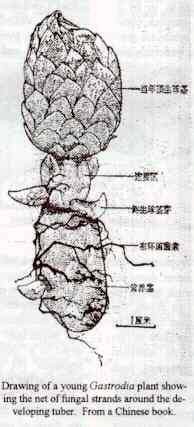
In some species (Gastrodia, Danhatchia and Corybas cryptanthus in New Zealand) chlorophyll never does develop, so the orchids rely for all their lives on associations with fungi. In others, the leaf-size is too small to support the rest of the orchid, and the orchid continues to rely partly on the fungus for its nutrition (Corybas cheesemanii for instance); such plants have been called saprophytic, but that is an incorrect application of the term. Some plants of the European Spiranthes spiralis pass alternate seasons underground, apparently fully nourished by their fungus during that time; some NZ orchids do not appear above ground every year and may do the same.
Most terrestrials seem to thrive better in the wild than in pots (some cannot be cultivated “artificially” at all), probably because they must have access to at least some of their nutrition via their ~ association.
In different terrestrial orchids the fungi penetrate the stems, tubers or root hairs, via epidermal (“skin”) cells after hyphae have spread over the root surface [2]. Pelotons are formed, and eventually digested.
“Symbiosis” suggests mutual benefit and indeed Cymbidium and its fungus each require the vitamin thiamine, made up of thiazole and pyridine; the fungus supplies the thiazole and the orchid supplies the pyridine [3]. Most orchid-associated fungi can, however, live without the orchid, and it seems that whereas the fungus supplies the orchid with a range of nutrients and stimuli, the orchid usually provides little in return.
Many orchids have “host” cells that store fungus, and adjacent digestion cells that break the fungus down by means of substances known as phytoalexins. The partnership between orchid and fungus has been called symbiosis (a ‘Swan situation’ as the politicians say in Wellington these days), or a “delicately balanced mutual antagonism’ [4], or plain parasitism (of the orchid on the fungus, that is.
Fungi that are apparently symbiotic can turn nasty and attack the orchid; furthermore the fungi of epiphytes may invade the orchid’s host tree to the tree’s (and ultimately the orchid’s) detriment.
Some studies in the laboratory suggest that specific orchids require specific fungi, but few associations have been studied in the wild. Fungi are difficult to isolate and difficult to grow (especially to the usually readily identifiable perfect state), and even in one orchid species, the fungus required by the protocorm may be different from that required by the adult. Certainly some orchids can establish successful relations with several different fungi.
Perkins has looked at the Australian orchids Pterostylis acuminata and Microtis parviflora in the wild and in the laboratory [19, 20]. Whereas only a few species of fungi were associated in the wild, several more would form associations in the laboratory – thus, ecological specificity” (what happens in the wild) is different from “potential specificity” (what could happen if laboratory experiments were to reflect the wild state) [18].
In 1911 Lancaster showed that fungal hyphae do penetrate the root hairs of NZ epiphytes and form pelotons which are digested by the orchid cells [5].
Ella Campbell began a series of papers on the fungal associations of NZ’s nongreen orchids in 1962 [6-10]; she showed: –
All around the roots of taraire trees grow the hyphae of the puftball fungus Lycoperdon perelatum, and these form a network around and attach to the rhizomes of Danhatchia australis, invade the tips of root hairs, and are digested by the cells of the orchid. The orchid is parasitic on the fungus, which in turn derives nutrients from, and may damage, the roots of the taraire [9].

Corybas cryptanthus has an associated unidentified fungus that invades the roots through root hairs attached at tiny conical projections; the fungus spreads among the beech leaf litter, and is a weak parasite on the Nothofagus[10].
J.H. Warcup, M. Clements, K. Dixon and A. Perkins and their co-workers have been the major contributors to the study of Australian orchid/fungus relationships [2, 11-21]. Readers interested in delving deeper are referred to these authors (for instance Warcup [16] gives an excellent general overview of the fungal relationships of South Australian orchids). Here are a few snippets.
Orchids that form ecologically specific relationships with single pollinating insects can only survive in the presence of that specific insect. We now see that there are orchids which form ecologically specific relationships with single mycorrhizal fungi: they can only survive in the presence of that specific fungus. How these observations apply to the New Zealand species is open to speculation.
Acknowledgements
I am grateful to Dr A.J. Perkins for supplying a list of Australasian papers.
References

“Fertilizers sprayed on the leaves of trees and shrubs are more effective than soil applications?”
By Linda Chalker-Scott, Ph.D., Extension Horticulturist and Associate Professor, Puyallup Research and Extension Center, Washington State University
Recently, I received an email from a professional colleague whose clients often ask about foliar feeding
as a method of fertilizing plants. As he says, “All the water soluble fertilizer companies advertise the
practice all the time.” What, he wondered, was my opinion of the practice?
Foliar feeding involves spraying the foliage of target plants with water-based fertilizers. The logic for the
practice is based on scientific research from the 1950’s, which demonstrated that leaves can take up
minerals through their stomata, and in some cases through their cuticles. This research is consistently
cited in the argument that foliar feeding is 8, 10, or even 20 times more effective than traditional soil
application.
In assessing the advertised claims for foliar feeding of shrubs and trees, I had particular questions that are
answered in bulleted lists below (all bullets are directly from marketing media):
(1) What are the advantages of foliar feeding over soil application?
• Immediate results
• Prolong bloom
• Increase crop yields
• Increase storage life of food crops
• Boost growth during dry spells
• Increase cold and heat tolerance
• Increase pest and disease resistance
• Maximize plant health and quality
• Help the internal circulation of the plant
(2) When should one use foliar nutrients sprays?
• When the soil is too cold for conversion of nutrient elements into usable forms
• When it is at least 72°F
• Any time except when it is too hot or too cold
• Transplant time
• Bloom time
• When a quick growth response is desired
• After fruit set
• Every 2-3 weeks
• Any time of stress
• As long as the plant has leaves that aren’t dormant
• When the soil is deficient in nutrients
(3) What time of the day, and in what quantity, should you apply foliar fertilizers?
• Early morning
• Until it drips from the leaves
• There is no improper way
(4) How long will material last on the leaves?
• 24 hours
• 1-2 days
• Four weeks
(5) What nutrients are critical components of foliar feed fertilizers?
• Nitrogen
• Phosphorus
• Micronutrients
(6) Apart from commercial formulas, what should homemade mixtures contain?
• Seaweed
• Compost tea
• Natural apple cider vinegar
• Blackstrap molasses
• Fish emulsion
• Baking soda
As one company states, “In our opinion, foliar feeding is by far the best approach to use to insure
maximum growth, yields, and quality by overcoming limitations of the soil and its ability to transfer
nutrients into the plant.”
The Reality
If these laundry lists look more like a multiple choice test rather than solid information, it’s not surprising.
Foliar feeding is yet another agricultural practice best suited to intensive crop production under specific
soil limitations rather than as a landscape management tool. Thus, advertisers take great liberties with the
facts, often resulting in contradictory messages (note especially the recommended temperature
conditions!). Rather than individually refute the numerous errors in the claims, I’ll explain when foliar
feeding might actually be beneficial.
The original 1950’s research came from Michigan State University and was particularly useful in
understanding how nutrients move within plant tissues. As explained by Dr. Tukey in his testimony to
the Joint Committee on Atomic Energy, use of radiolabelled nutrients allowed his team to discover
“…that a leaf is a very efficient organ of absorption. The amounts may at first seem relatively small, but
to offset this handicap, the efficiency is high.” From this advertisers claim that foliar feeding is 8, 10 or
20 times more effective than soil application. This is not accurate for several reasons.
Obviously, materials applied directly to a leaf are more likely to enter the leaf in large quantity than the
same materials applied to the soil. Leaching, chemical reactions, microbial activity, etc. can decrease
what actually reaches the roots and is taken up into the plant. But materials applied to the leaf do not
necessarily travel throughout the entire plant as effectively as they do through root uptake. They often
remain in the same or adjoining tissues but travel no further. This is especially true of those elements
recognized as “immobile” within plant tissues (apart from root uptake and xylem transport).
Research over many decades has explored the mineral uptake and transport of many species of fruit trees,
conifers including pine and spruce species, and some hardwoods of ornamental or commercial value.
Results have been mixed in many cases, with some species responding well to treatment and others
remaining unaffected. Generally, the results suggest that foliar application of particular nutrients can be
useful in crop production situations where soil conditions limit nutrient availability.
For instance, alkaline soils do not readily release many metallic nutrients, especially iron and manganese. Zinc,
copper, magnesium, molybdenum, boron, and calcium are other micronutrients required in small
quantities that have been applied to foliage in an effort to relieve deficiencies and combat fruit disorders.
Fruit, as adjacent tissue, can benefit from foliar spray. But this is a localized application that does not
affect the trunk or roots – and therefore is not a solution to soil imbalances. In fact, researchers
consistently state that foliar treatments are a specialized, temporary solution to leaf and fruit deficiencies
in tree fruit production but will not solve larger soil management issues.
On the other hand, macronutrients, such as nitrogen, phosphorus and potassium, are needed in larger
quantities. While many of these are mobile in the plant, it is pointless to apply them to foliage as leaves
cannot take up enough material to supply the entire plant’s demands. Furthermore, foliar application of
high concentrations of such nutrients often results in leaf burn as water evaporates and the fertilizer salts
remain behind. Substituting numerous, lower concentration applications would not be cost effective.
Species differ widely in their ability to take up nutrients through their leaves. Differences in cuticle
thickness, stomatal resistance, and other genetic factors will influence uptake, as will environmental
conditions. Plants in a protected situation (like a greenhouse) have thinner and more porous cuticles than
plants in the field and take up foliar sprays much more readily. Likewise, plants adapted to arid
environments naturally have thicker, less penetrable cuticles than those from more moderate locations.
A better management solution to the problem of nutrient availability is to choose plants that can adapt to
the existing soil conditions. If you have alkaline or calcareous soils, for heaven’s sake don’t install acid
loving plants! Poor plant selection in terms of mineral nutrition will be a management problem for the
lifetime of the plant – which may be pretty short. Choose cultivars of species that are more resistant to
alkaline soils – they are able to acidify the root environment so that micronutrients are remobilized from
the soil and available for uptake.
The existing research does not justify foliar fertilization of landscape plants as a general method of
mineral nutrition. It can be useful for diagnosing deficiencies; for instance, spraying leaves with iron
chelate can help determine if interveinal chlorosis is from iron deficiency. It would obviously have
benefit for those landowners with landscape fruit trees that perpetually have flower or fruit disorders
associated with micronutrient deficiencies. Applying fertilizers to leaves (or the soil) without regard to
actual mineral needs wastes time and money, can injure plant roots and soil organisms, and contributes to
the increasing problem of environmental pollution.
The Bottom Line
• Tree and shrub species differ dramatically in their ability to absorb foliar fertilizers.
• Proper plant selection relative to soil type is crucial to appropriate mineral nutrition.
• Foliar spraying is best accomplished on overcast, cool days to reduce leaf burn.
• In landscape plants, foliar spraying can test for nutrient deficiencies, but not solve them.
• Micronutrients are the only minerals that are effectively applied through foliar application.
• Foliar application will not alleviate mineral deficiencies in roots or subsequent crown growth.
• Foliar spraying is only a temporary solution to the larger problem of soil nutrient availability.
• Minerals (especially micronutrients) applied in amounts that exceed a plant’s needs can injure or
kill the plant and contribute to environmental pollution.
• Any benefit from foliar spraying of landscape trees and shrubs is minor considering the cost and
labor required.
This article is designed to be a primer centered around the topic of Mycorrhizae and their interactions with plants.

The question and answer format will help you learn how life in the soil benefits your plants health and how to increase the presence of mycorrhizae and other beneficial life in your soil. This will allow you to harvest the best possible crops whether it be in your home garden or on a larger scale such as an orchard or field.
Intro
In modern society we are generally taught to stay away from bacteria, fungi and other microbes and tend towards sterile environments or ones with little diversity. In reality these little creatures are an essential part of any natural ecosystem and are necessary to grow the best plants. The most abundant and resilient farming systems have soil health at their core, a large component of which is soil life. The important types of soil life are almost too numerous to count but a certain group of fungi, the Mycorrhizae, have been well studied and linked to increased plan growth, vigour and health.
What are Mycorrhizae?
Mycorrhizae are types of soil fungi that live in a mutually beneficial symbiosis with plants. They grow in, on and around the roots of plants helping the plant to get more out of the soil. They help make the root zone of the plant as beneficial as possible.
How does it Help?
Mycorrhizae essentially increase the surface area available to the plants roots, acting as little networks of root  extensions. This allows for the plant to be able to reach more nutrients and minerals more efficiently than it could on its own. The plant feeds the mycorrhizae extra sugars it produces and in turn the mycorrhizae brings in water, nutrients and minerals the plant needs. It’s a mutually beneficial arrangement that has had hundreds of millions of years in the making. Many plants still grow without mycorrhizae but not as well or as quickly as they would with it.
On top of being able to grow faster and larger with an extended and enhanced root system, there are many other benefits to mycorrhizae in the soil. Having a healthy population of good microfauna can help ward off certain diseases like ones caused by unwanted fungi or bacteria. The enhanced root system can also grow deeper and hold more water within itself, making any crop more drought tolerant. There is also a measurable benefit to larger root systems aerating and putting more carbon into the soil, help to build it up and make it more suitable for life of all sorts. Unfortunately many soils are depleted of mycorrhizae and other life for various reasons.
What can cause a loss of Mycorrhizae?
The leading causes of loss of mycorrhizae are harsh agricultural practices. Certain crop sprays like pesticides and fungicides can kill mycorrhizae or prevent them from growing back properly. Other disruptive practices like deep tilling, burning, and leaving soil bare can also greatly affect the life in soil, including the mycorrhizal fungi. These fungi normally exist in undisturbed and naturally mulched soils so when they are churned or baked in the sun, they do not fair well. Mimicking the best conditions is the easiest way to promote healthy mycorrhizal fungi populations.
Building Mycorrhizal populations
While properly managed soils should in theory recolonize with microfauna over time, the turn-around time is on the scale of years if not decades. One of the best, and quickest, ways to jump start your soils health and biodiversity, especially if it is degraded or damaged, is to add an inoculant like MycoGold by Biostim ( https://biostim.com.au/shop/myco-gold/) . Inoculants contain beneficial types of Mycorrhizal fungi and some of the best, like MycoGold, contain other beneficial microorganisms too. Inoculants are an easy and cost effective way to make sure your plants or crop are starting out with the microbiome they need to flourish.
Other Factors affecting Soil Health
Soils of all types can support healthy life of some sort but certain factors affect how well microbes and mycorrhizal fungi can grow and support your plants. Below are some other factors to consider in building and maintaining healthy soil microfauna.
Moisture/Sun Exposure- While dry soils can have lots of dormant microbes in them that will spring to life when  water comes, a steady source moisture is required to keep them active and thriving. Making sure your soil doesn’t bake in the sun or dry out for prolonged periods of time can help keep it healthy. A great way to do this is to never leave the soil bare, whether it is seeded with a cover crop or mulched heavily, shading the soil and preventing it from drying is essential to healthy soil life.
Drainage/Aeration-While moisture is important it is also important that the soil does not become waterlogged or compacted. The best way to ensure this is to have an inorganic component like sand in your soil.
Organic Matter- Organic matter acts like a sponge, helping hold moisture in the soil near to the surface where the soil life can get it. As discussed above, having moisture readily available has a large impact on soil life.
Mineral Content-While organic matter is great, soils that are completely organic matter, such as pure black top soil, can sometimes be mineral deficient. This can not only affect the health of your plants directly but also through the soil life. Little microbes and fungi need minerals too! They can be the first one to feel deficiencies as they are competing with the plants for them in a way. This is why adding things like rock dust, crushed shale, or even sand can help boost the life in your soil. These soil additives will give back two-fold. Indirectly though better capacity for soil life and directly through uptake into the plants.
A Cyclical System
Having healthy soil life, like a strong mycorrhizae population, not only helps with your current growing but for several crops or plantings to come. When the soil is alive and healthy, it is essentially growing, getting better and more plant friendly as time goes on. The actual lifetime of the full effect of an application of a soil inoculant may vary based on several of the factors discussed above. However, meeting the guidelines for health soil and promoting healthy soil life can help the effect last for years, theoretically forever in a cyclical process of regenerating the soil.
We all feed the feed we believe is best for our horse. We add on those pricey but necessary, and oh so carefully selected supplements. We choose hay that is good quality, and a pasture that is free of toxic plants. Our horses are our best friends, our athletes, our partners and our family. We strive to keep their well being in mind, and pour hundreds of dollars into their health every year. Yet so many of us overlook the most basic and fundamental substance that our horses need to consume not just to thrive, but even survive – water.
Giving your horse constant access to clean, fresh, water is one of the very basics of stable management. Many horse owners dedicate hours of research into their feed of choice, they meticulously gather information on any supplements they use, yet when it comes to water, why do so many of us fail to see its importance? We tackle feeding with a fine toothed comb, giving so much careful consideration to what we choose to input into our horses, yet so many of us let the most basic input of all go unchecked.

Water isn’t just consumed by your horse every time he dips his head to the bucket you fill each night in his stable. The automatic drinkers, the stream running through the pasture, the field trough or the pond he likes to wade in, all give him access to water too. This water isn’t pure just because it appears clean, and though we police what we put into our horse’s body feed-wise, so many of us forget to question, what exactly is water bringing to that mix? As a natural solvent, this liquid picks up little pieces of the environments it has travelled through. From minerals through to chemicals or bacteria, so much can be dissolved in water, while us, and our horses, are none the wiser.
One end to this uncertainty, and a safeguard against it, is water testing. Many barns today, draw their water from wells, making testing even more important as potential for contamination is particularly high. Even water from a main public or city line can, in some cases, be a cause for concern. Although this kind of water is filtered and tested extensively at the source, any fault from there on out, be it in the pipes, the storage, or the plumbing, still results in a problem with the end result – the water you provide for your horse. Though water may appear clean and safe, it is impossible to tell what levels of which harmful compounds are, or aren’t, lurking hidden inside that bucket, without testing it.

Test results show you the levels of the compounds and bacteria in your horse’s drinking water, and even the pH. One compound that can be tested for is Magnesium. Along with Calcium, these salts could be giving you ‘hard’ water. While this is usually no problem for your horse, at high levels, Magnesium can cause unpleasant diarrhoea in equines, meaning being in the know is important. Iron is also on most test panels. Underground, the compound is usually colourless, but on exposure to air or heat, it has the potential to stain water red or rusty in colour and carry a metallic taste. This iron can lead to iron loving bacteria, which feed on the compound and create a rusty slime that covers the inside of your pipes, reducing their effectiveness and lifespan. Another mineral worthy of mention, is lead. Although its effects on horses are not well understood, we’ve all heard the term ‘lead poisoning’ and it’s not hard to imagine high levels are best avoided.
 Total coliforms levels check your water for bacteria that usually lives in soil and both animal and human waste. Though these bacteria themselves are not particularly harmful, their presence can act as an indicator that your water supply may be contaminated with run off water from a septic tank, or even the muckheap, paving the way for contamination with things you definitely do not want your horse drinking! Pesticides and extremely harmful substances such as blue-green algae can also be identified through having your horse’s water checked. Testing puts you in the know, and arms you with the information you need to make choices about exactly what your horse’s drinking water exposes him to.
As well as protecting your horse, water testing can also be beneficial for increasing the lifespan and integrity of your pipes and fixtures. For example, pH, which tests the acid or alkaline levels in water, is helpful in this area. Acidic water can contribute to corrosion of pipes, while an alkaline result suggests a high chance of deposits of crusty minerals lining your pipes, reducing their efficiency.
It is advised that water supplied by a well is tested annually, though if any changes in your water occur, it might also be time to get tested. This could include a change in colour, odour or taste of the water, as well as any horse, human or other animal getting sick with a water-borne disease, flooding occurring near your water supply, or work being carried out on the pipes or other fixtures.
In addition to testing, following a few common sense water tips can also pay dividends when it comes to staying in control of what your horse consumes, and making sure he stays healthy. All water buckets, baths, or troughs should be checked and filled daily, to ensure a continuous supply of clean water. This applies to automatic drinkers too. Be vigilant for any signs of contamination, be it build up of dirt, algae, or poop, and ready to clean accordingly! Don’t allow horses to have access to any stagnant or contaminated water, and if you’re not sure that the water is safe, remove access and find another source, until it has been tested and has the all clear.
It can be difficult to find specific guidelines for horse’s drinking water, as generally they are lumped into the livestock category. By undertaking water testing, you can at least ensure that the water they consume is, clean, safe, and is suited to their needs as possible. After all, the average horse drinks at least half a gallon of water for every 100 pounds of their body weight, per day, giving it the power to make a significant difference to their overall wellbeing. Water testing eliminates the unknown. It ensures that you really do have rule number one of good stable management down, by confirming the water your horse has access to really is clean, and safe for him to drink.
By Emma Doherty – Luna Sport Horses
Second only behind big, red barns, the farm dog is an iconic set piece in farm history. Thought of as companions, herders, guardians and more, these dogs fill a major need for farms, even still today. But what makes a farm dog a farm dog? What traits should you be looking for? What breeds fit those traits? These are important questions to ask when trying to determine what kind of dog you need on your farm.
Are you looking for a companion dog that can stay by your side through the day and at night protect your family and maybe some small livestock? Are you looking for something to herd a flock of a sheep or a large herd of cattle? Whether you are looking at getting a farm dog to to watch the chickens or a dog that will be out in the fields working with you all day, you have to get the right breed for the job. Selecting the proper breed, doing the proper training, and assigning a fitting job are all parts of successfully owning a farm dog.
Selecting the Right Breed
Selecting a breed isn’t as simple as going to a pet store and picking out a pup. You need to do your homework and prepare yourself for the next step. First, take a look at what you are trying to do. If you are needing to herd sheep, look for intelligent dogs that have a high work drive, low prey drive, and can protect the flock if needed from predators. If you are herding cattle, look at breeds that are small, low to the ground, and are practically fearless. They, too, will need that working instinct. If there are other jobs, such as pulling, guarding or pest control, you’ll need to factor these in as well.
Once you have done your research, you need to prepare yourself and your home for a new dog. This is no different than if you were getting a dog for personal companionship. Making sure you have the food, toys, a bed, a crate. They’ll still need training, everything from basic obedience and potty training to training for the job you intend them to do. Some dogs have a natural instinct to herd or guard, so training that as early as possible is a great way to capitalize on that instinct.
Let’s take a look at each specific job and understand what it is that is needed, and what breeds best fit those jobs.
Sheep Herding
Herding sheep requires a softer touch than herding cattle does. This is why it’s important to get the right breed for sheep herding. Working in tandem with their handler, a well-trained herding dog will listen to the commands (and in some areas of the world, whistles!) to determine where and how fast to move the sheep. Using these commands, the dog is able to herd the sheep wherever the owner needs them. This means they can move them into pens, new grazing areas, away from dangerous areas, or away from feeding pens so the owner can put out feed without being trampled.

To successfully control the sheep in such a way, you need a calm, yet authoritative, approach, or else the sheep may end up to riled up and won’t move the way you want them to. This is why it is imperative that your dog remain calm yet willful, without being too much to spook the sheep.
The best breeds for sheep herding are Border Collies and Australian Shepherds. There are other breeds that can herd sheep, but none do it with the grace of these two dogs. A border collie, for example, uses the commands it’s owner gives him, and moves the sheep through eye contact. A well trained border collie need not bark or move too much, as eye contact alone will get the sheep moving. This is called “active-eye” or “strong-eye” herding. Border collies, however, are extremely energetic dogs, and without a job to do, can become extremely destructive. This is why they make such good herding dogs.
If, however, your herding needs are less demanding, an Australian Shepherd may be a better choice for you. Aussies, while still having that high work drive, are not quite as energetic as border collies and are usually content with an honest days work. They herd the sheep by moving around them, gathering them into a group, and literally commanding them where to go by walking behind them. This is called “loose-eye” herding. Typically, aussies work in groups instead by themselves, and this allows them to work a herd of sheep easier, as the way they make them move requires lots of movement behind the flock, cutting behind the flock and forcing them to move in the direction they want.
Cattle Herding
Cattle herding requires a lot more than sheep herding. This is due, in part, to the large size of the animals. Aside from that, cattle are known to be stubborn, so you need a strong-willed dog (and a strong will of your own) to make it work. The biggest thing to remember is that herding cattle can be very dangerous, for you and the dogs working with them. One false step, one mis-timed nip, one mistake can lead to serious injury or worse. Again, this warning is not just for the dogs, but yourself as well.

Unlike sheep, cattle are typically herded physically. While the dogs still listen to commands, they are rougher with the much larger cattle. This is typically done by nipping at the heels, or cutting, similar to what aussies do for sheep (and can do with cattle, as well). Cattle herding is done, typically, with loose-eyed dogs.
Two great breeds for cattle herding may shock you. The Australian Cattle Dog and the Corgi (both breeds). Many people may assume you need a bigger, tougher dog to drive cattle, but the truth is, these two miniscule breeds have it where it counts. These two were bred extensively for cattle herding. Australian Cattle Dogs, specifically, were bred to work in the herd, running between cows, nipping at heels and driving them for stockyards. The Corgi was bred to drive cattle as well, and does it much the same way the Australian Cattle Dog does.
Other Jobs
There are other jobs that happen on a farm that a dog can help with. For example, if you need something that can pull a cart, but would rather use a dog than a pony, a Bernese Mountain Dog makes a great puller! Another job could be pest control. If your farm is low on livestock but high on crops, pests can be a big problem. Thankfully, dogs like the Jack Russel Terrier were bred specifically to deal with pests.
Often times, a dog is needed to protect a flock of sheep from predators. Dogs like the Great Pyranese and German Shepherd can not only herd, but are great protectors as well. They act as guardians to the flock, and are able to hold their own against any would be predator.
Don’t Judge a Book
You’ve heard the phrase don’t judge a book by it’s cover. That principle applies to herding dogs as well. Just because it’s a Border Collie doesn’t mean it’s going to be fit for herding. Just because it’s a Corgi doesn’t mean it’s ready for cattle. You need to look for dogs from working lines, with strong working instinct. And don’t be pigeonholed into a certain breed based on what they are good at working. An Australian Shepherd can work cattle, and a Cattle Dog can work sheep and goats.

The important thing is finding the right dog for the job. If you follow the advice, do a lot of research, you’ll find the perfect match for your needs. Just keep learning and not only will you find the right dog for the job, but you’ll find a great companion as well.
by Kimberly LeMaster